
Beat the best world model in one 10-minute A100 run
Train a world model of Craftax-Classic on 500k frames in 600 s on one A100, score it with the frozen eval.py, and take the crown. The higher score wins.
score over time
Each point is one iteration; it links to its code. Higher is better.
leaderboard
| # | author | change | score ↑ | gFVD ↓ | logic ↑ | memory ↑ | reward AP ↑ | done AP ↑ | train s | code | weights |
|---|---|---|---|---|---|---|---|---|---|---|---|
| loading records.jsonl… | |||||||||||
Best first. Score: 0 for a trivial model, 1 for the real game. Mean ± sample SD over training seeds 0, 1 and 2, each trained cold on one Colab A100 and scored by eval.py; gFVD shown ×10⁴. Train s is the slowest seed. Data: records.jsonl.
beat it
Beat the best and yours is the next iteration: the crown goes next to your GitHub login, and the player on the home page switches to your model. Hand it to your coding agent:
Or do it by hand: program.md has the loop, the rules and the model interface, written for people and for coding agents.
the rules
Beat the best score in one 600-second A100 run.
- data
train.npzon Hugging Face, 500k transitions. Nothing else, no pretrained weights.- compute
- 600 s on one A100 40GB, everything included: tokenizer, data loading, compilation. No compile cache.
- eval
eval.pyis frozen. Loading your model, compiling and generating every clip must take at most 300 s on the maintainer's Colab A100 (iteration 3: about 147 s). Any model, any sampler, any context length.- frames
- One frame per action: the model never sees future actions or frames.
- seeds
- The score is the mean over training seeds 0, 1 and 2.
- gates
- Ranked on the score alone, checked in the maintainer's rerun on the same machine and seeds, on a private test set built the same way from other worlds.
The score must beat the best mean by a noise-aware margin, where sd is the sample SD over the three seeds:
new − best > 1.65 · √((sd_best² + sd_new²) / 3)
The three-seed means of the two heads must stay at or above fixed floors: reward AP ≥ 0.872 (95% of iteration 1) and done AP ≥ 0.15. The floors do not move when the best changes. Each eval.py row also flags its own run against them, for information only.
evaluation
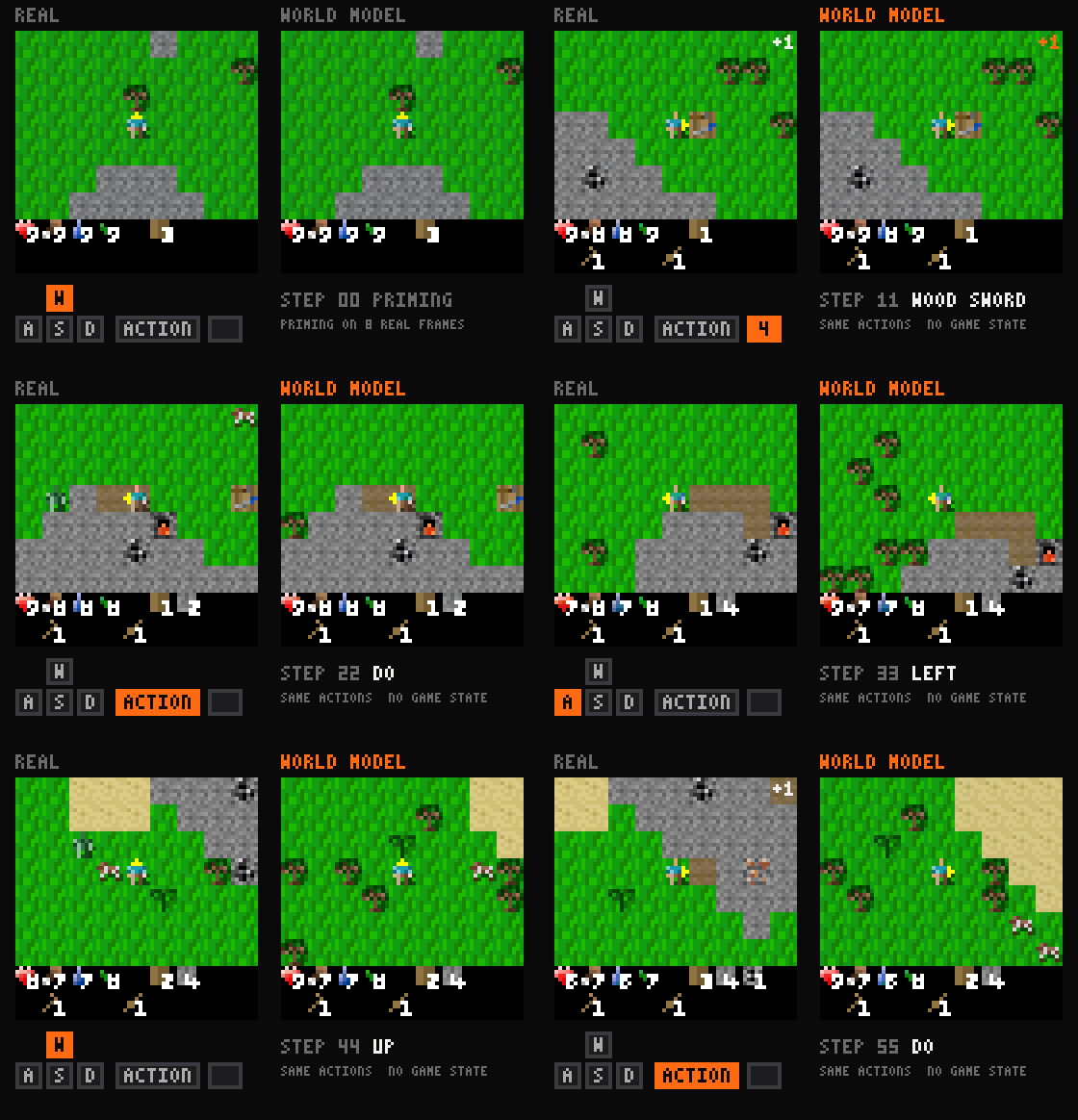
The frozen evaluator scores clips of held-out play from other worlds. Eight real frames prime the model, then it generates one frame per recorded action. Probes read the generated frames with the game's own textures: HUD digits, map cells, the sleep tint. The eval takes under 3 minutes on one A100.
- score ↑
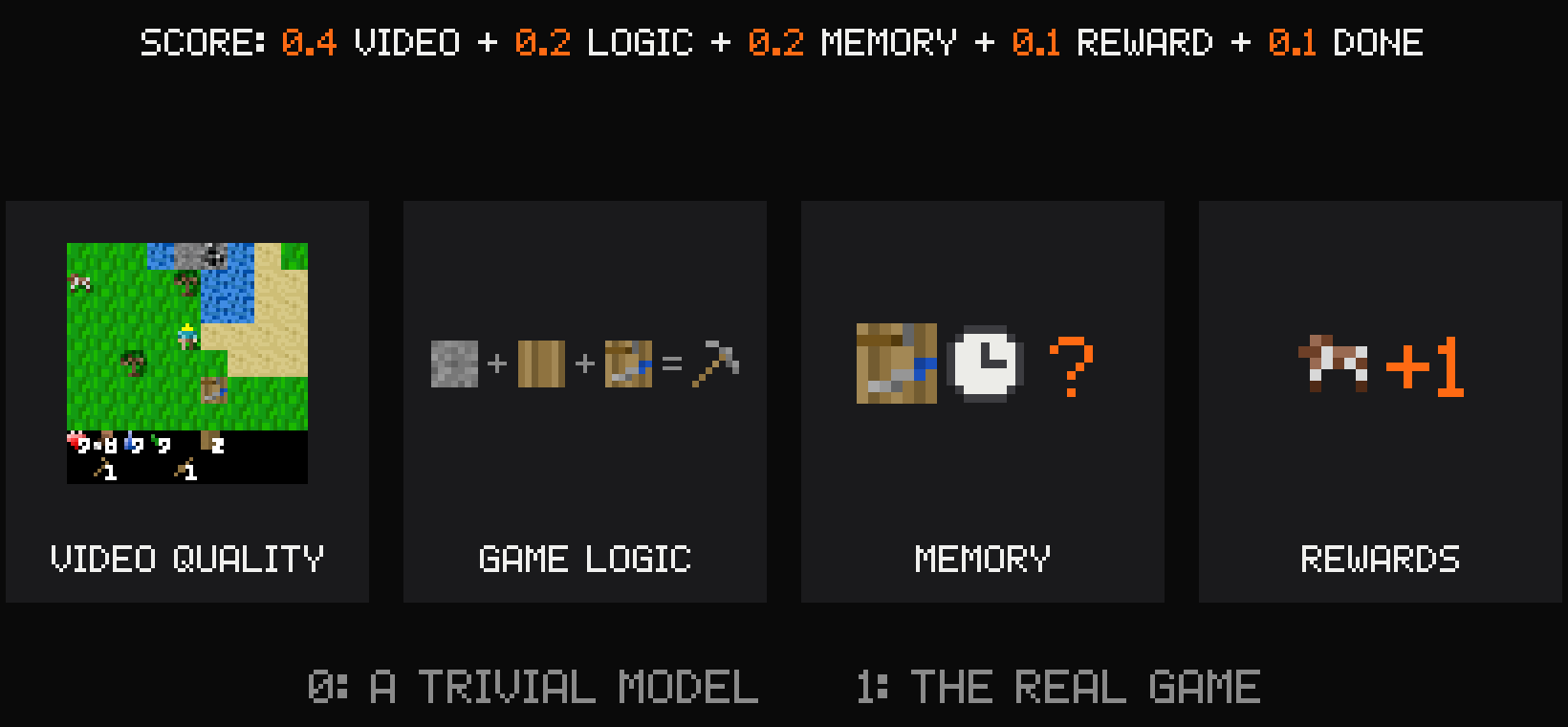
- The headline: 0.4 gFVD + 0.2 logic + 0.2 memory + 0.1 reward + 0.1 done, each part clipped to [0, 1]. gFVD on a log scale from copying the last frame (170, scores 0) to the real game replayed with fresh randomness (14, scores 1); logic; memory; reward and done as the AP's gain over its base rate, (AP − base) / (1 − base). Copying the last frame scores 0. Looping the eight context frames gets 0.23, all from gFVD, without learning anything, so the rules ask for a learned model. A weighted geometric mean of the same parts is logged for comparison; the ranking uses the score.
- logic ↑
- Eight scripted actions from a real state next to something to use: chop, mine, drink, eat, place, craft, sleep, with and without the right tool, table, furnace or ingredients, crafts in any order. Per family, the pass rate where the game changed something plus the pass rate where it did not, minus 1.
- memory ↑
- Walks out and back (48 and 144 actions), half recall and half self-consistency, each in gap buckets from 4-7 to 64+ frames. Recall: map cells seen in the context come back into view and should be drawn as the real block, scored as a gain over drawing a random block of the last context frame. Self-consistency: cells the model drew itself leave the view and come back, and should look the way it drew them before. Past 16 frames, recall is near chance for every model so far.
- gFVD ↓ (×10⁴)
- The Fréchet distance between real and generated clips over all 64 generated frames, in the feature space of a fixed random CNN. It needs no external checkpoint and is not comparable to I3D FVD.
- reward AP ↑ and done AP ↑
- The average precision of the reward and episode-end heads on real transitions; the base rate (the share of positives) is logged next to each.
how to submit
The full loop, rules and model interface are in program.md, for people and for coding agents.
- Train seeds 0, 1 and 2 and score each with
eval.py. Every run appends a row toledger.jsonl. - Open a pull request with your code, the three ledger rows and links to the three checkpoints on Hugging Face, so anyone can play and score them.
- The maintainer retrains the three seeds next to the best on a Colab A100. If the rerun passes the gates, it is the next iteration: the crown goes next to your GitHub login, and your model becomes the one the site plays. If it does not export to the browser with
docs/export_web.py, the maintainer helps.